Money & payments
Kantors in Poland: how to exchange money without losing out
Poland's high streets are full of small exchange offices – kantors – and the best of them beat any bank. The worst, usually the ones nearest the airport gate or the most famous square, quietly take a tenth of your money. Here is how to tell them apart in thirty seconds.
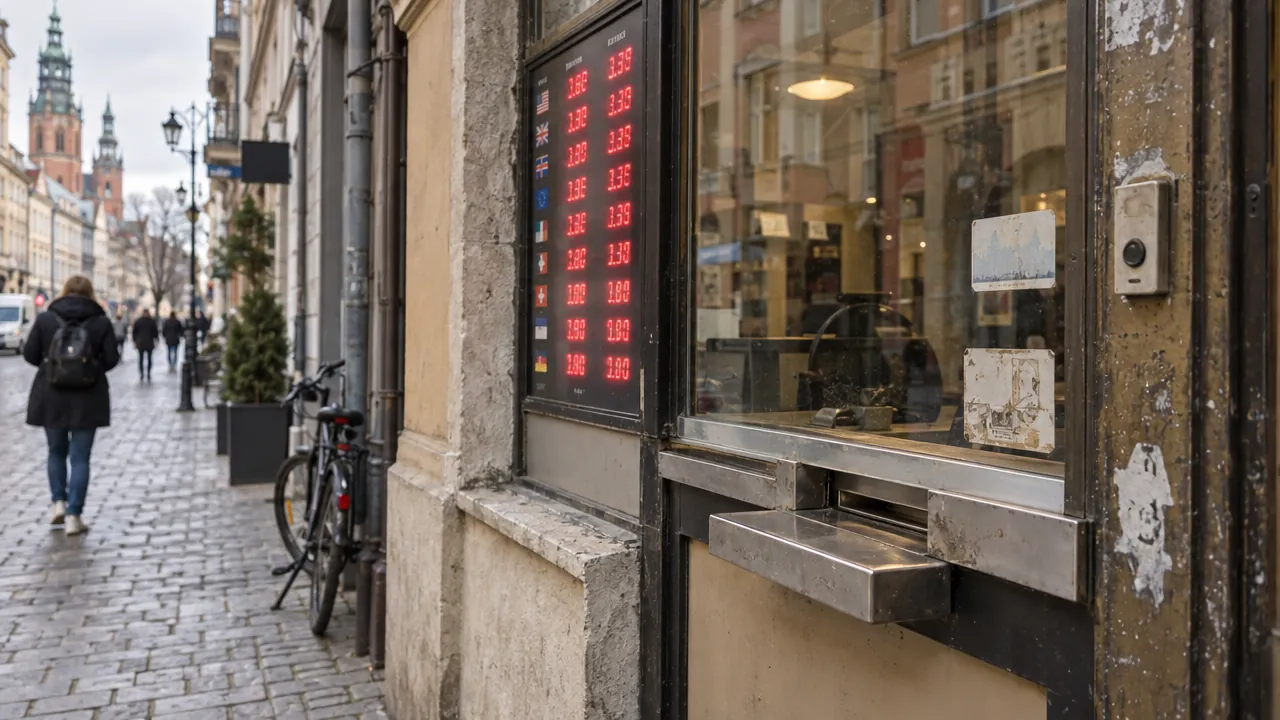
Walk down any Polish high street and you will pass a kantor every few hundred metres: a narrow shopfront, a glass booth, an electronic board of flags and four-digit numbers. They are a Polish institution, left over from the 1990s, when swapping currency was part of everyday life – and they are still the cheapest way to turn cash euros, pounds or dollars into złoty.
The catch is that rates vary enormously. A good kantor in a side street takes a margin of one or two per cent. A kantor in the arrivals hall or on the main tourist square can take five times as much, while advertising “0% commission” in large letters. The difference on a €300 exchange can be the price of a good dinner.
The short version
- Bring a little cash, not a lot. Cards are accepted almost everywhere in Poland; you only need złoty for small stalls, toilets and tips. See Polish currency, cards and ATMs.
- Change only a small amount at the airport – enough for the train or a coffee.
- Use a kantor in the city centre, away from the main square – and compare two or three.
- Ignore “0% commission” signs. In Poland kantors do not charge commission; the cost is always in the rate.
- Know the fair rate before you go in. Our currency converter at the top of every page shows the official National Bank of Poland rate.
How to read the rate board
Every kantor must display its rates. The board has two columns for each currency:
| Polish | English | Which one matters to you |
|---|---|---|
| Kupno | We buy | When you sell euros, pounds or dollars and get złoty – the usual case for visitors |
| Sprzedaż | We sell | When you buy foreign currency with złoty – for example, changing leftover złoty back at the end of a trip |
So if you arrive with €200, look at the kupno column next to EUR: the higher the number, the better. If you are changing złoty back to euros, look at sprzedaż: the lower the number, the better.
Is the rate fair? A 30-second check
- Check today's official rate in our converter (the złoty button at the top of the page) or in your banking app.
- Compare it with the kantor's kupno rate.
- Within 1–2% of the official rate: a good kantor. 3–4%: acceptable for a small amount. 5% or more: walk on.
Example: if the official rate is 4.25 złoty per euro, a good kantor will buy your euros at around 4.17–4.21. A kantor offering 3.95 is taking about 7% – €14 on every €200.
Where rates are good – and where they are bad
Usually poor:
- Airports, especially in the arrivals hall
- Next to the biggest sights – on and around the main market squares and the busiest tourist streets
- Inside shopping centres and hotels
- Anywhere with a large “0% commission” or “no fee” sign and no rates on display
Usually better:
- Kantors on ordinary shopping streets a few minutes' walk from the tourist centre
- Kantors near business districts and big transport hubs used by locals
- Established kantors with a long queue of locals – a good sign
Rates can be a little worse in the evenings and at weekends. Larger amounts sometimes get a better rate – ask.
Kantor, ATM or card?
| Best for | Watch out for | |
|---|---|---|
| Card payments | Almost everything – shops, restaurants, transport, museums | Always choose to pay in złoty (PLN), never in your home currency |
| Bank ATM | Getting a modest amount of cash | Decline the ATM's “conversion” offer; avoid standalone Euronet machines, which add fees and poor rates |
| City-centre kantor | Changing cash you already have | Check the rate first; avoid airports and tourist squares |
| Bank branch | Rarely worth it | Margins are usually higher than a good kantor |
For most visitors the best combination is a card with no foreign-transaction fees for everyday spending, plus a small amount of cash from a bank ATM or a city-centre kantor.
Changing złoty back
Kantors buy back złoty too – but you will lose on the spread twice. Try to spend down your cash on the last day, or keep a few notes for your next trip. Coins cannot be exchanged back at all.
Tips
- Count your money at the counter before you walk away, and keep the receipt.
- Use clean, undamaged notes – kantors may refuse torn or heavily marked notes, or give a worse rate.
- Do not change money with people in the street who offer a “better rate”. It is illegal, and the notes may be fake.
- Most kantors take only cash. Some accept cards, but then you pay your bank's conversion as well.
Sources
- FX Europe: Best exchange rates in Warsaw (February 2026) – typical kantor and bank spreads, airport margins, “0% commission” and ATM fees
- National Bank of Poland: daily mid-market exchange rates (table A)
Prices and opening hours change – we re-check them regularly. Spotted something out of date? Let us know.