Money & payments
Polish currency: the złoty, cards, cash and ATMs
Poland does not use the euro. Here is what the złoty is worth today, how to pay, and the simple rules that stop you losing money on exchange rates.
Złoty converter
Loading today’s rate…
Does Poland use the euro?
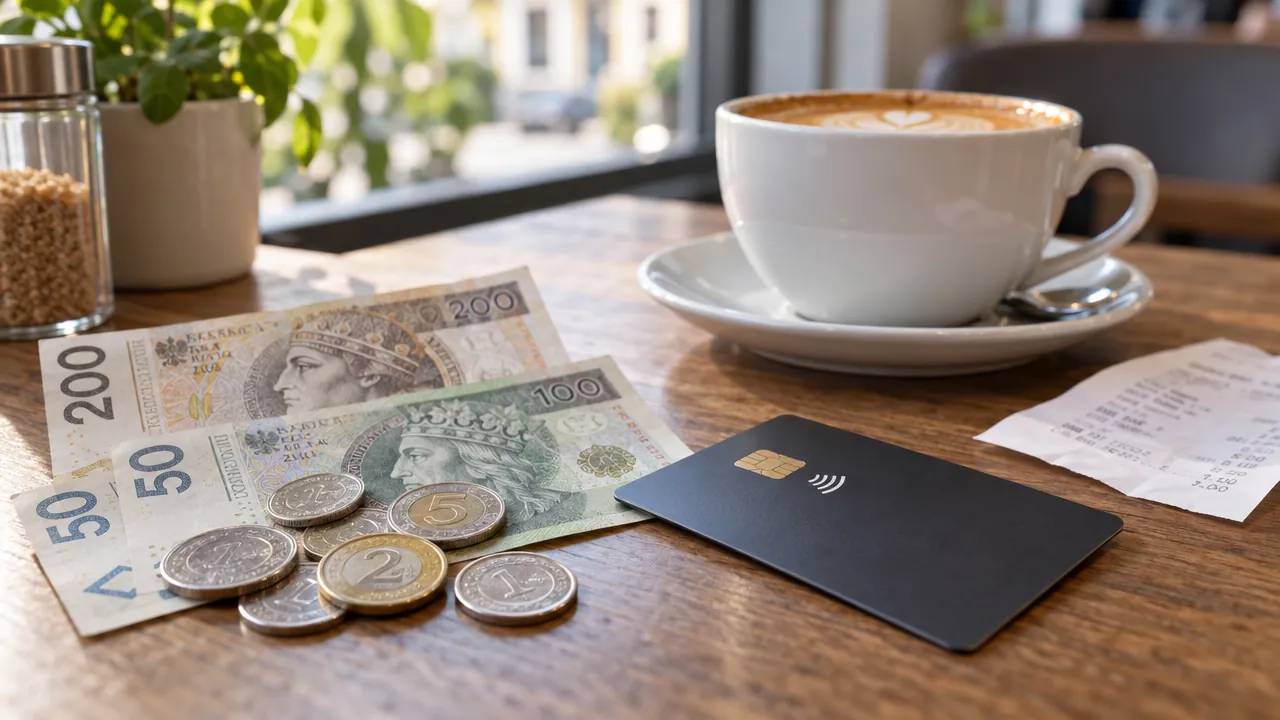
No. The currency is the Polish złoty (pronounced roughly zwo-ti), written zł in shops and PLN on exchange boards and bank statements. One złoty is divided into 100 groszy (gr).
Poland is in the EU but has not adopted the euro, and there is no date for doing so. A few hotels, tourist shops and border markets will take euros, but almost always at a poor rate and with change in złoty. Pay in złoty – by card or cash – and you will nearly always pay less.
Notes and coins
| Notes | Coins |
|---|---|
| 10, 20, 50, 100, 200 and 500 zł | 1, 2, 5, 10, 20 and 50 gr; 1, 2 and 5 zł |
The 200 and 500 zł notes are hard to break in small shops, markets and taxis. Ask for 50s and 100s when you exchange money.
Card or cash?
Cards are accepted almost everywhere – supermarkets, restaurants, museums, public transport ticket machines, taxis and even many market stalls. Contactless payments are standard, and Apple Pay and Google Pay work wherever cards do.
A little cash is still useful for:
- small kiosks, some market stalls and bakeries
- public toilets, which often cost a few złoty
- tips, if you want to leave them in cash
- rural areas and small guesthouses
For a city break, 100–200 zł in cash is plenty for most people.
Always pay in złoty – the one rule that matters
When you pay by card or use an ATM, the screen will often ask whether you want to be charged in złoty or in your home currency. Always choose złoty (PLN).
If you pick your home currency, the shop's or ATM operator's bank does the conversion – a service called dynamic currency conversion – and its rate is usually much worse than the one your own bank or card would give you. The same applies to the question “Do you want to see the amount in euros?” at restaurant card terminals.
Getting cash from ATMs
ATMs are called bankomaty and are everywhere. Two tips:
- Use ATMs that belong to a bank (look for a bank's name on the machine, ideally in or next to a branch). Independent ATM networks, common in tourist areas and airports, often add their own withdrawal fee and push you towards their conversion rate.
- Decline the conversion and choose to be charged in złoty, as above. If the machine offers a fixed amount that is much larger than you need, choose “other amount”.
Check what your own bank charges for foreign withdrawals before you travel – many travel-friendly cards and app-based banks charge nothing or very little within certain limits.
Exchanging money at a kantor
If you bring cash, change it at a kantor (exchange office). They are everywhere in city centres and usually give better rates than banks.
- Avoid kantors at airports, railway stations and on the most touristy streets – their rates can be much worse. Change a small amount at the airport if you must, and the rest in town.
- Compare the buying and selling rates on the board. The smaller the gap between the two, the fairer the kantor.
- Ignore “0% commission” signs – what matters is the rate you get. Ask how many złoty you will receive before you hand over your money.
- Count your money at the counter before you leave.
Euros, pounds, dollars and Swiss francs are easy to exchange; less common currencies may get poor rates.
Paying like a local: BLIK and contactless
Poles mostly pay by card, phone or BLIK, a mobile payment system built into Polish banking apps. BLIK only works with a Polish bank account, so visitors will not need it – but if you move here, you will use it every day. More in our guide to BLIK and contactless payments.
Tipping
Tipping is customary but modest. In restaurants with table service, around 10% is normal for good service; in cafés and bars people often round up. One useful local quirk: if you say dziękuję (“thank you”) as you hand over cash, the waiter may take it to mean “keep the change”.
Quick checklist
- The currency is the złoty (PLN), not the euro.
- Pay by card in złoty; always decline conversion to your home currency.
- Use bank ATMs, not independent machines in tourist hotspots.
- Exchange cash at a kantor in town, not at the airport.
- Carry a little cash in small notes for kiosks, toilets and tips.
Planning purchases you want to take home? See Tax Free for non-EU visitors. Wondering what things cost? Our chapter on prices and budget is in preparation.
Sources
- Exchange rates: National Bank of Poland (NBP), table A mid rates, loaded live
Prices and opening hours change – we re-check them regularly. Spotted something out of date? Let us know.