Bolesławiec pottery
Polish pottery (Bolesławiec): the complete guide
Cobalt-blue dots, peacock eyes and hand-stamped flowers – Polish pottery from Bolesławiec is one of the most loved things to bring home from Poland. Here is everything you need to know before you buy.
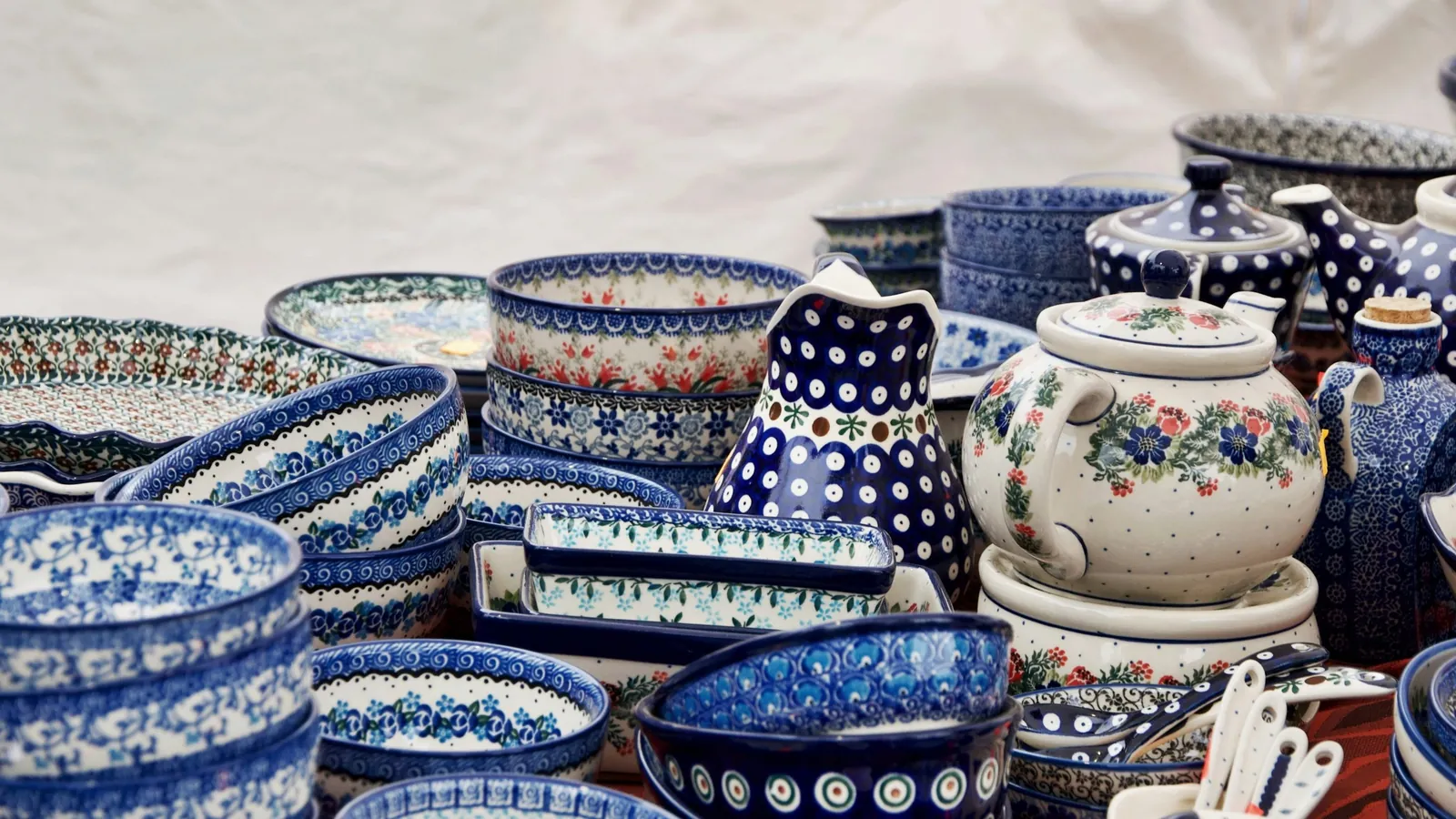
What is Polish pottery?
“Polish pottery” usually means stoneware from Bolesławiec, a small town in Lower Silesia, south-west Poland, about 50 km from the German border at Görlitz. In German it is known as Bunzlauer Keramik, after the town's German name, Bunzlau.
It is made from local white clay, decorated by hand with small sponge stamps and brushes, glazed and fired at a very high temperature. The result is tough, everyday tableware – mugs, plates, bowls, teapots, baking dishes – in instantly recognisable patterns, most often in cobalt blue on a creamy white base.
Six hundred years in one mug
- The beginnings: potters were working in Bolesławiec at least from the 15th century, and by 1511 the town had a potters' guild. Early wares were brown-glazed jugs and tankards.
- Bunzlau: the town became Prussian in 1742 and its pottery became famous across the German-speaking world as Bunzlauer.
- A new look: in the 19th century potters refined the local clay, switched to a lead-free feldspar glaze and, from the 1880s and 1890s, began decorating pieces in blue and white with hand-cut sponge stamps. The famous peacock's eye pattern (pawie oczko) became the town's signature in the early 20th century.
- After 1945: Silesia became part of Poland and the German population was expelled. From 1946 Polish ceramic artists were brought in to revive the craft, and in 1950 the cooperative that became Ceramika Artystyczna was founded. Its training workshops produced a new generation of Polish artisans.
- Today: several manufacturers and dozens of small workshops make pottery in and around Bolesławiec, and it is exported all over the world – especially to Germany and the United States.
How it is made
- Shaping – pieces are thrown on a wheel or cast in moulds from local clay.
- First firing – the raw piece is fired to make it strong enough to decorate.
- Hand stamping – artisans dip small stamps cut from sponge into paint and press the pattern onto the pottery piece by piece, adding details with a brush. No two pieces are exactly alike.
- Glazing and second firing – the piece is dipped in a clear glaze and fired again at about 1,250 °C, which makes the stoneware hard, non-porous and durable.
Patterns and Unikat
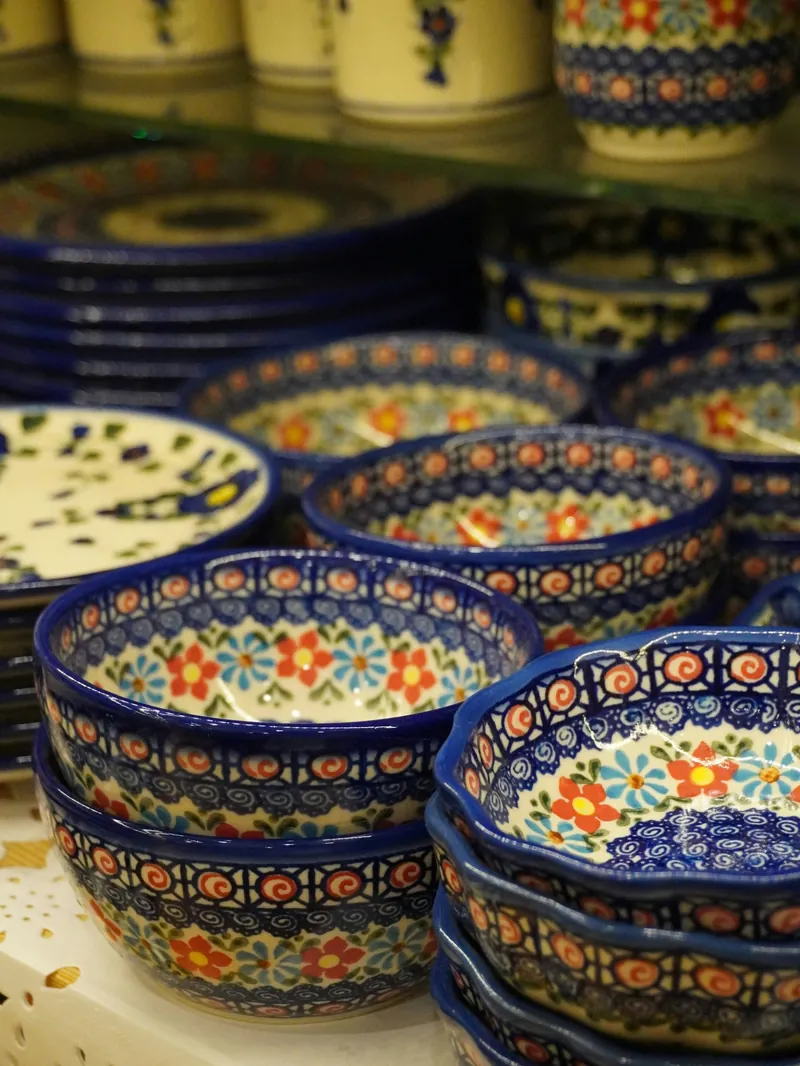
There are hundreds of patterns, from the classic peacock's eye and simple blue dots to flowers, berries, hearts and seasonal Christmas designs. Each manufacturer has its own catalogue, and patterns are often known by numbers or nicknames.
Unikat (“unique”) is the top tier: pieces decorated by the most experienced artisans with more complex, colourful designs. They are signed on the base by the artist and cost noticeably more than standard pieces. We explain the patterns in more detail in our guide to patterns and Unikat.
How to spot the real thing
Cheap imitations – often printed rather than stamped – are sold in tourist shops and online. Genuine Bolesławiec pottery:
- has the manufacturer's stamp and “Hand made in Poland” on the base
- shows small variations and overlaps in the stamped pattern – a perfectly uniform print is a warning sign
- feels heavy and solid, with a smooth, glossy glaze
- is sold in Bolesławiec factory shops, specialist stores and reputable dealers
Many pieces are also marked with a quality grade (gatunek). First quality is flawless; second quality has small cosmetic imperfections and is sold more cheaply – a good way to buy everyday pieces for less. More in marks, stamps and value.
Is Polish pottery safe to use?
Genuine Bolesławiec stoneware is made for everyday use. Manufacturers state that it is lead-free and safe for the oven, microwave and dishwasher; it is also generally used in the freezer. A few tips:
- Avoid sudden temperature changes – do not put a cold dish into a hot oven or a hot dish on a cold, wet surface.
- Put bakers into a cold oven and let them warm up with it.
- Do not use pieces on a stove top or under a grill.
- Pieces with gold or metallic decoration are not microwave-safe.
Where to buy Polish pottery in Poland
- In Bolesławiec – the best choice and the best prices. Most manufacturers have factory shops (often with second-quality pieces), and the town centre is full of pottery shops. Plan half a day; see visiting Bolesławiec.
- In the big cities – Kraków, Wrocław, Warsaw and Gdańsk have specialist shops, often near the main squares. Prices are higher than in Bolesławiec but still lower than abroad.
- At Christmas markets – some stalls sell genuine pottery, others imitations; check the base.
- From abroad – specialist shops in Germany, the UK and the US sell Bolesławiec pottery, and you can order online. See outlets and where to buy.
Taking it home by plane? Pack pieces in your hand luggage or wrap each one in clothes in the middle of your suitcase – stoneware is tough, but not unbreakable.
Visiting Bolesławiec
Bolesławiec is easy to reach by car or train from Wrocław (about 1.5 hours) and from Dresden or Görlitz in Germany. Besides the shops, it has a Ceramics Museum and a pretty market square. Every August the town holds the Ceramics Festival (Święto Ceramiki) – several days of pottery stalls, workshops, factory tours, parades and concerts. In 2026 it took place on 19–23 August.
Sources
- My Modern Met: Bolesławiec pottery – history and how it is made
- Ceramika Artystyczna (official website): founding in 1950, sponge-stamping technique, firing at 1,250 °C, lead-free glazes, oven, dishwasher and microwave use
- Wrocław.pl: Bolesławiec Ceramics Festival 2026 programme
Prices and opening hours change – we re-check them regularly. Spotted something out of date? Let us know.