What to bring home
Baltic amber: how to buy real Polish amber jewellery (and spot the fakes)
For thousands of years, the Baltic Sea has washed up lumps of golden fossil resin on Poland's beaches – and Gdańsk has been turning them into jewellery since Roman times. Amber is still Poland's most precious souvenir. Here is how to make sure that what you buy is the real thing.
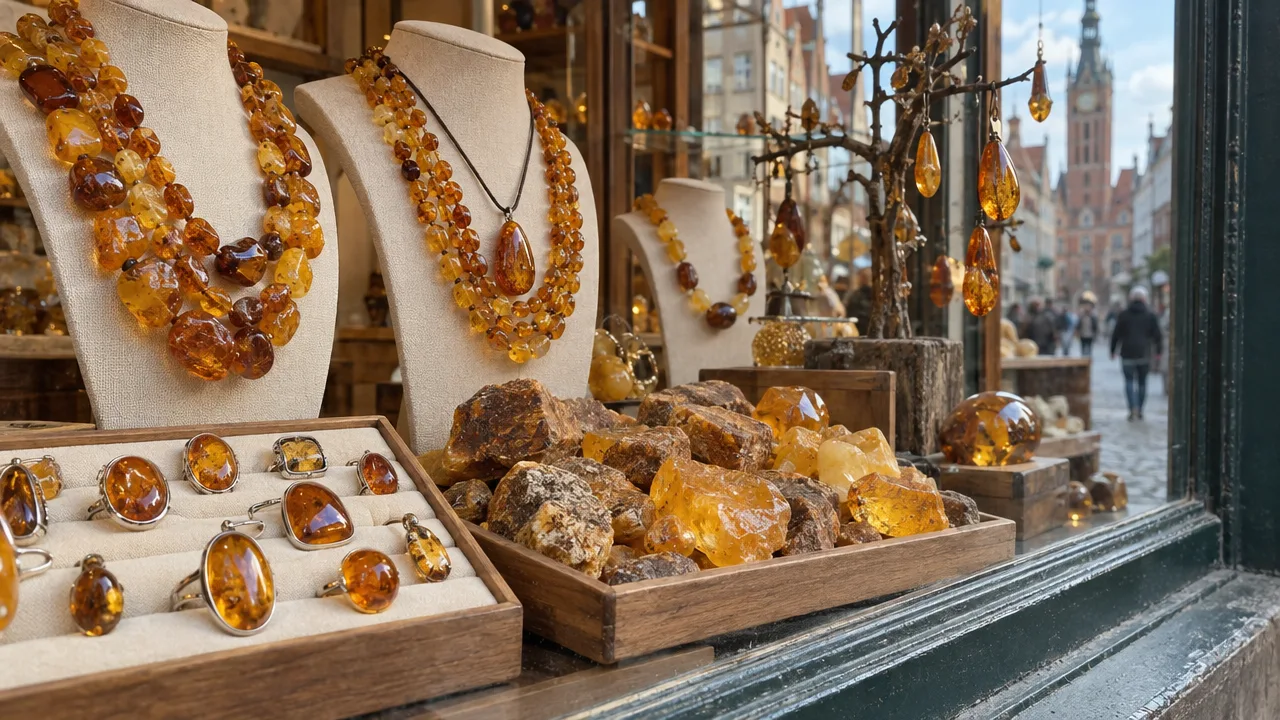
Gdańsk calls itself the world capital of amber, and with some reason: the city's workshops have been cutting and polishing it since the Middle Ages, the merchants of the Hanseatic League traded it across Europe, and the Roman-era “Amber Road” ran from the Baltic coast to the Adriatic. Today, Mariacka Street in the old town is lined with amber galleries, and you will find amber jewellery in every Polish city.
You will also find a lot of fakes. The good news is that real amber is easy to recognise once you know what to look for.
What amber is
Amber is fossilised tree resin, not a stone. Baltic amber – known to scientists as succinite – formed from the resin of ancient forests some 40 million years ago and is found along the coasts of Poland, Lithuania and the Kaliningrad region of Russia, both washed up on the beaches and dug from the ground. It is light, warm to the touch and soft enough to be carved with a knife. Pieces sometimes contain insects, plants or bubbles trapped when the resin was still liquid – these inclusions are prized by collectors.
Types and colours
| Type | What it is | Worth |
|---|---|---|
| Natural | Polished but otherwise unchanged; often cloudy, with a natural surface or bubbles | The most valuable |
| Heated or clarified | Heated to remove cloudiness and bring out colour; the shiny “sun spangles” in clear amber are a result of this | Real amber, the most common in jewellery |
| Pressed (reconstructed) | Small pieces of amber melted together under heat and pressure | Real amber, but worth much less; often very uniform |
| Green amber | Natural amber heat-treated in a special way to darken it | Real amber, treated |
Amber comes in many colours: honey and cognac (the most common), cherry and dark red, lemon yellow, milky white royal or “butterscotch” amber, and the green described above. Natural opaque white and butterscotch amber are the rarest.
Real or fake? Five checks
The imitations are usually plastic, resin, glass or copal – a much younger tree resin that looks like amber but is not yet fossilised.
- Weight and touch. Amber is very light and feels warm. Glass is cold and heavy; many plastics and resins feel heavier than they look.
- Salt water. Dissolve about two tablespoons of salt in a glass of water: real amber floats, glass and most plastics sink. (Do not try this with jewellery in metal settings.)
- Look closely. Natural amber has slightly irregular colour, tiny bubbles or specks. A set of perfectly identical, glossy beads in exactly the same colour is often pressed amber or plastic.
- Static. Rub amber on wool or your sleeve and it will pick up tiny scraps of paper. The ancient Greeks' word for amber, elektron, gave us the word “electricity”.
- UV light. Under a UV torch, Baltic amber usually glows a soft green, yellow or bluish-white; many plastics do not.
Tests with a hot needle or a solvent do work, but they damage the piece – leave them to the jeweller or a laboratory.
Certificates and labels
- Ask for a certificate of natural Baltic amber for any significant purchase. Reputable galleries provide it, and many belong to the International Amber Association, based in Gdańsk, which certifies the amber its members sell.
- Check the description on the label or receipt: “Baltic amber” and whether it is natural, heated or pressed. An honest seller will tell you.
- Silver settings should carry a hallmark; Polish silver is usually 925.
Where to buy
- Gdańsk – Mariacka Street (ulica Mariacka): the most beautiful amber street in the world, a cobbled lane of stone terraces and galleries between St Mary's Church and the Motława river. Prices are higher than elsewhere, quality generally good – compare a few shops.
- Gdańsk – the Amber Museum, a branch of the Museum of Gdańsk, at the entrance to the Royal Way – worth visiting before you shop. A new exhibition section is devoted to counterfeit amber.
- Kraków – galleries around the Main Square and in the Cloth Hall (Sukiennice), where you can find good pieces among the souvenirs.
- Warsaw – galleries in the Old Town and jewellers in the city centre.
- The Baltic coast – resort towns such as Sopot, Międzyzdroje and Jantar (“amber” in Polish) have amber shops and, in Jantar, an amber-fishing championship.
- Online – buy from galleries with their own shops and certificates, or from marketplace sellers with detailed descriptions and good reviews. Be wary of very cheap “Baltic amber” from unknown sellers.
Prices
Prices depend on size, colour, rarity, workmanship and the silver or gold setting. As a rough guide in Poland:
- small pendants and earrings in silver: from about 50–150 zł,
- rings and bracelets: from about 100–400 zł,
- necklaces of natural amber beads: from a few hundred złoty to several thousand for large, rare colours,
- collector pieces with inclusions or large natural specimens: from hundreds to many thousands of złoty.
Anything that looks large and cheap at a street stall is probably not natural amber. Visitors from outside the EU can reclaim VAT on purchases over 200 zł – see Tax Free in Poland.
Finding your own amber
Planning a trip to the coast? See our guide to the best beaches in Poland.
After winter storms, amber is washed up on the beaches of the Baltic coast, especially east of Gdańsk, on the Vistula Spit. Look along the line of seaweed and driftwood at the water's edge, early in the morning after a strong north wind. Small pieces are common; large ones are rare. Picking up a few pieces on an ordinary beach is fine; in national parks such as Słowiński and Woliński, take nothing away.
Caring for amber
- Keep it away from perfume, hairspray, alcohol and household cleaners – they dull the surface.
- Clean it with a soft cloth and lukewarm water; dry it straight away.
- Store it separately from harder jewellery, which can scratch it, and away from heat and strong sunlight.
A note on amber teething necklaces
Amber teething necklaces for babies are widely sold, but there is no scientific evidence that they ease teething pain, and health authorities in several countries warn against them because of the risk of strangulation and choking. They are not a gift we recommend.
More gift ideas in our guide to souvenirs from Poland. Visiting Gdańsk at Christmas? See our guide to the Gdańsk Christmas market.
Sources
- Museum of Gdańsk – Amber Museum (amber.com.pl): museum information, new exhibition module on amber forgeries (from December 2025)
- International Amber Association (Międzynarodowe Stowarzyszenie Bursztynników), Gdańsk – certification of Baltic amber
- Gemstones for Sale: Amber buying guide – simulants, salt-water and UV tests, pressed amber
- US Food and Drug Administration: warning against amber teething necklaces (2018)
Prices and opening hours change – we re-check them regularly. Spotted something out of date? Let us know.