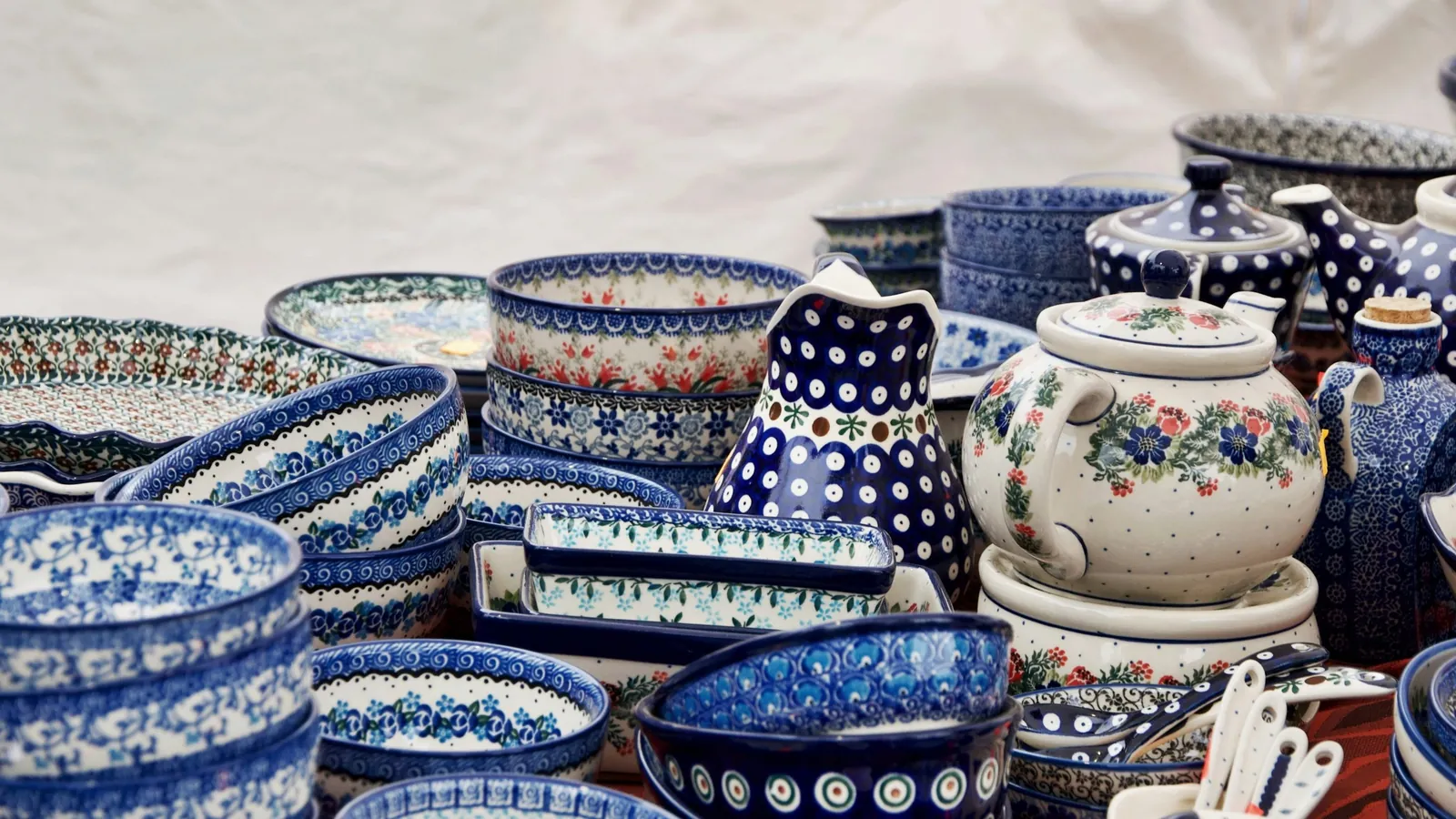
Bolesławiec pottery
Polish pottery marks: how to read the stamp on the base (and what a piece is worth)
Turn a piece of Polish pottery over and the base tells you almost everything: who made it, which pattern it is, whether it is a signed Unikat, and whether it is genuine at all. Here is how to read it.
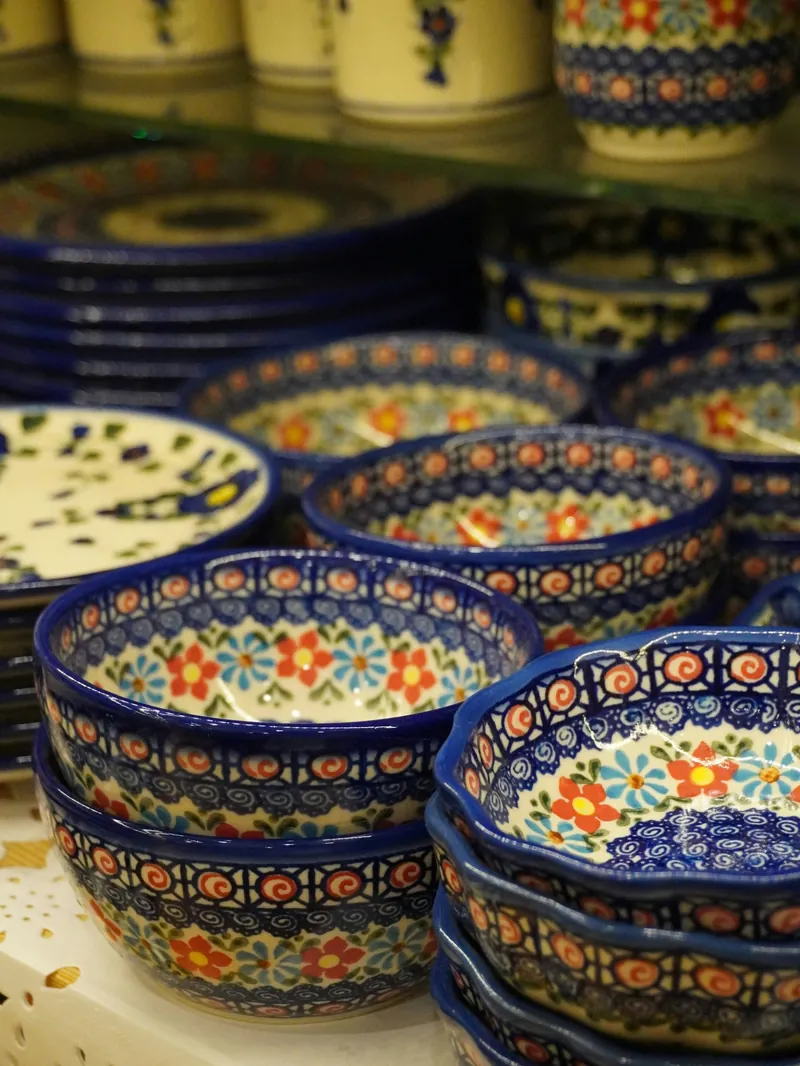
Every genuine piece of Bolesławiec pottery carries marks that are fired into the base – stamped or printed under the glaze, so they cannot be washed or scratched off. A piece with only a paper sticker, or with a smooth, blank base, is not Bolesławiec pottery, however convincing the pattern.
What you will find on the base
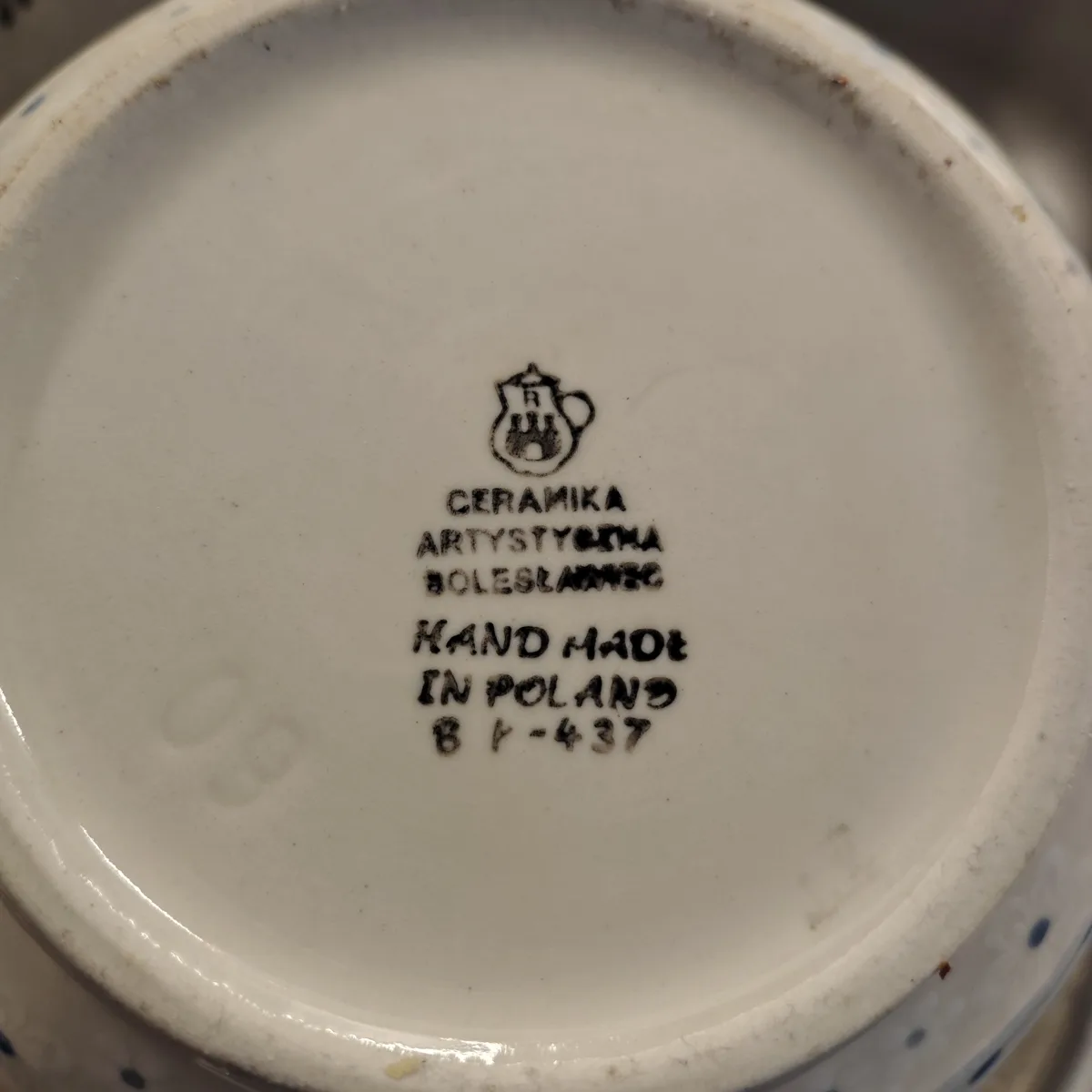
| Mark | What it tells you |
|---|---|
| Manufacturer's logo | Who made the piece – each factory has its own stamp |
| “Hand made in Poland” | Found on almost all genuine pieces |
| Pattern code | The decoration, for example a number, letters and numbers, or a code starting with “U” for Unikat |
| Shape code | The form – mug, plate, baker – often combined with the pattern code, as in 223-U3356 (shape 223, pattern U3356) |
| Artist's signature or number | Who decorated it; always present on Unikat pieces |
| “Unikat” or “Unique” | A top-tier, individually decorated piece |
| Quality grade | Sometimes shown for second-quality pieces – the way it is marked varies by manufacturer |
Not every piece has every mark, and each manufacturer does things slightly differently – but the manufacturer's stamp and “Hand made in Poland” should always be there.
The main manufacturers and their marks
Dozens of workshops make pottery in and around Bolesławiec. These are the names you will see most often:
- Ceramika Artystyczna (CA) – the cooperative founded in 1950, one of the largest makers and famous for its small-dot sponge work, the peacock's eye and its signed Unikat range. Its logo, used since 2000, is a jug with the towers of the Bolesławiec coat of arms inside. Shape codes are plain numbers.
- Zakłady Ceramiczne “Bolesławiec” (ZCB) – the oldest works in town, dating from 1946, known for traditional cobalt designs. It has used several logos over the years, including a cat (registered in 1982), an oval logo (from 1997) and a “three towers” logo for unique and artistic designs (from 2001). Shape codes have four digits.
- Manufaktura w Bolesławcu – a large maker with a strong line in layered floral designs and modern patterns; shape codes combine letters and numbers.
- Ceramika Kalich – a family company founded in 2001, widely exported, especially to the US.
- Vena – known for contemporary colours and artist-signed Unikat pieces; three-digit shape codes.
- Smaller workshops – such as Kaola and others around Bolesławiec, each with its own stamp, usually including the word Bolesławiec.
Genuine Bolesławiec pottery is made by producers based in the Bolesławiec area. A piece that says only “Polish style” or “Made in…” somewhere else is an imitation.
Unikat signatures
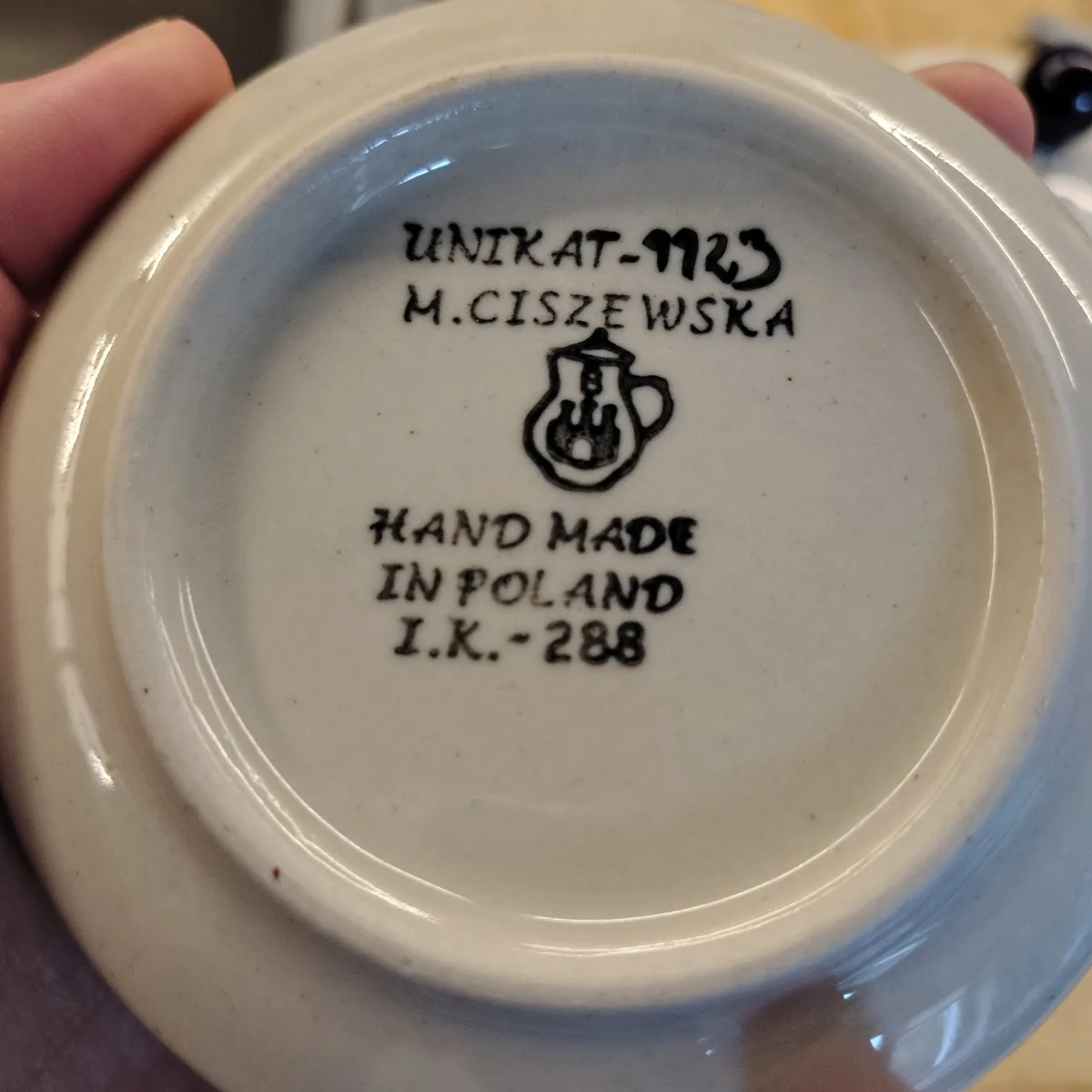
Unikat pieces are decorated by the most experienced artisans with more complex and colourful designs. On the base you will usually find:
- the word “Unikat” (or Unique) or a pattern code beginning with U,
- the artist's signature – a name, initials or a number,
- sometimes the date or period of production.
A signature from a well-known artist and a complex, labour-intensive design raise the value considerably. More about the designs in our guide to patterns and Unikat.
First and second quality
Manufacturers sort their pottery into grades. First quality (I gatunek) is flawless. Second quality (II gatunek) has small cosmetic flaws – an uneven glaze, a smudged stamp, a dot out of place – and is sold for noticeably less, mainly in factory shops. Some makers mark seconds on the base or with a sticker; others simply sell them on separate shelves. Seconds are perfect for everyday use. See Polish pottery outlets.
Old pottery: Bunzlau and communist-era marks
- Before 1945, when Bolesławiec was the German town of Bunzlau, pieces were marked by German potteries – often with the word “Bunzlau”, a maker's name such as Julius Paul & Sohn or Reinhold & Co., and sometimes “Germany”. Good pre-war Bunzlauer pieces are collected in Germany and the US.
- From the 1950s to the 1980s, pieces from the state-run works often carry simpler marks and “Made in Poland” or “Hand made in Poland”. Many have the brown-and-blue or simple cobalt designs of the time.
Older marks are less standardised; if a piece may be valuable, compare it with a specialist reference or ask a dealer.
What is my Polish pottery worth?
Most Bolesławiec pottery is everyday tableware and is worth roughly what it costs new. A piece is likely to be worth more when it is:
- a signed Unikat, especially by a well-known artist,
- large or unusual – big platters, tureens, teapots, lamps or rare shapes,
- in a discontinued or sought-after pattern,
- an old Bunzlau piece in good condition,
- first quality and undamaged – chips, cracks and crazing reduce the value sharply.
The best way to check is to search the pattern code and shape code on dealers' websites and in sold listings on online marketplaces. Prices in Poland are much lower than in the US, Germany or the UK, so a piece bought in Bolesławiec can resell for considerably more abroad.
Spotting a fake in ten seconds
- Turn it over. No fired-in manufacturer's mark, no “Hand made in Poland” – walk away.
- Look at the pattern. Stamped decoration shows small overlaps and variations; a perfectly even, sharp pattern is often a print or a transfer.
- Feel the weight. Genuine stoneware is heavy and solid.
- Check the price. Very cheap “Polish pottery” online is rarely genuine.
Everything else you need to know – history, care, prices, where to buy – is in our complete guide to Polish pottery. Buying online? Choose listings that show a clear photo of the base, such as those from specialist sellers on Amazon, and avoid anything without a manufacturer's mark.
Frequently asked questions
What does “Hand made in Poland” on the base mean?
It shows the piece was made and decorated by hand in Poland. On genuine Bolesławiec pottery it appears together with the manufacturer's logo, fired into the glaze – not printed on a sticker.
What do the numbers on the base mean?
Usually a shape number and a pattern number from the manufacturer's catalogue, sometimes with a quality grade. Search them on dealers' websites to identify and value the piece.
Is my old Polish pottery valuable?
Most pieces are worth roughly what they cost new. Signed Unikat pieces, large or rare shapes, discontinued patterns and old German Bunzlau pieces in perfect condition can be worth more.
What does “Unikat” mean on Polish pottery?
Unikat marks the top tier of pieces, decorated by the most experienced artisans and signed by the artist on the base.
Sources
- Uniceramic: How to recognise Bolesławiec ceramics – fired-in marks, manufacturers' logos (CA jug logo from 2000; ZCB cat 1982, oval 1997, three towers 2001), Unikat codes
- Blue Rose Pottery: Polish pottery pattern guide – pattern and shape codes by factory
- Polish Pottery Hagerstown: Our factories – Ceramika Artystyczna, Kalich, Kaola; Unikat signatures
- Zakłady Ceramiczne “Bolesławiec” and Ceramika Artystyczna (official websites)
Prices and opening hours change – we re-check them regularly. Spotted something out of date? Let us know.