Bolesławiec pottery
Polish pottery patterns and Unikat: the designs explained
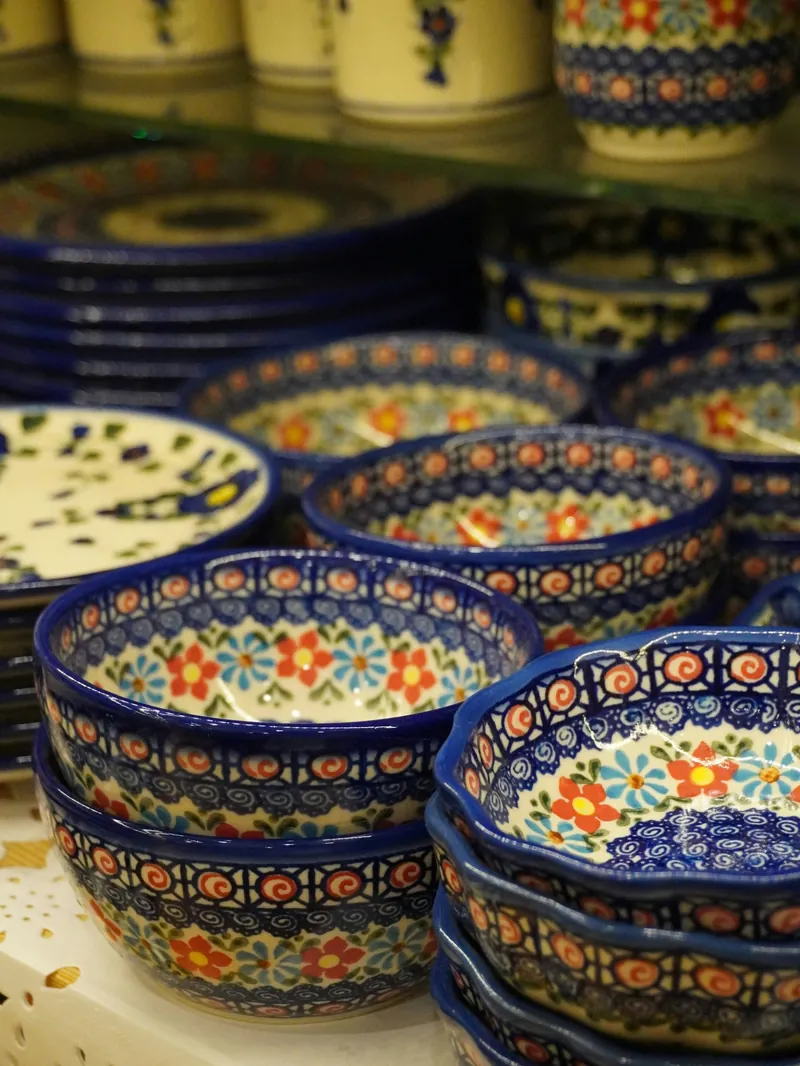
There are hundreds of Polish pottery patterns, and collectors can name most of them at a glance. Behind them is a simple technique – a sponge stamp, a brush and a steady hand – and a few classic motifs that have been repeated in Bolesławiec for more than a century.
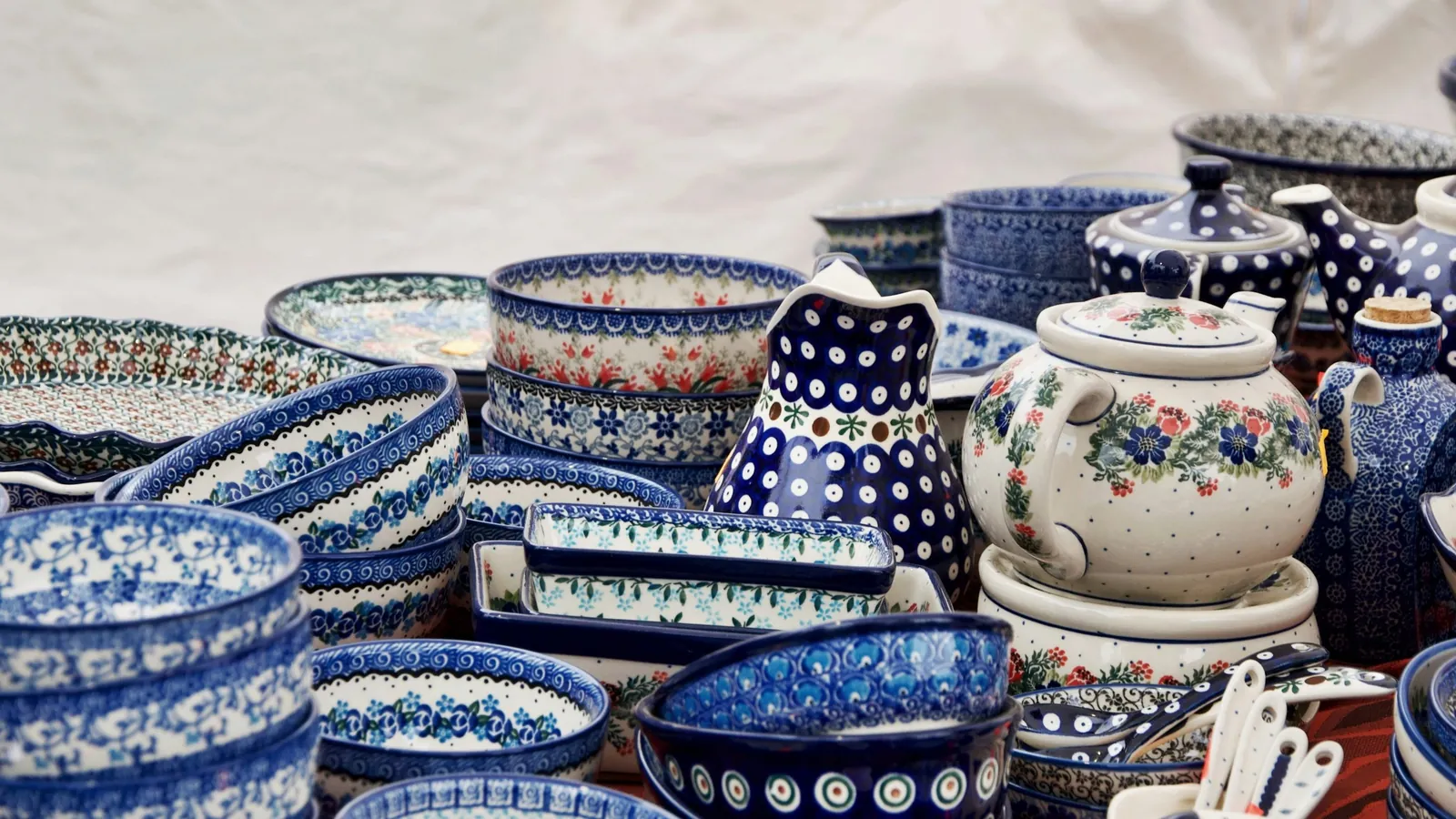
Every Bolesławiec pattern is built from the same few ingredients: small sponge stamps cut into dots, petals, leaves and lines, pressed onto the clay one by one, with details added by brush. Combine them differently – change the colours, the density, the arrangement – and you get a new pattern. That is why there are so many, and why no two pieces are exactly the same.
The classic motifs
| Motif | Polish name | What it looks like |
|---|---|---|
| Peacock's eye | pawie oczko | A ring of feather-like strokes around a dot, usually blue and green on white – the signature of Bolesławiec since the early 20th century |
| Dots | kropki | White dots on cobalt blue, or blue dots on white; often combined with other motifs |
| Flowers | kwiaty | Daisies, forget-me-nots, poppies, tulips, roses and stylised folk flowers |
| Berries and fruit | owoce | Strawberries, blueberries, cherries, grapes |
| Hearts and stars | serca, gwiazdki | Popular for gifts and Christmas |
| Seasonal designs | – | Christmas trees, snowflakes, Easter and autumn themes |
| Modern designs | – | Stripes, geometric patterns and new colours such as green, red, yellow and grey |
The peacock's eye is the pattern most people picture when they think of Polish pottery. It appears on its own, in bands around a mug or plate, and as part of more complex designs – look for it on pieces from almost every manufacturer.
How patterns are named and numbered
Each manufacturer has its own catalogue and its own numbering, so the same name can mean different designs at different factories.
- On the base, the pattern code is usually printed next to the factory mark – numbers, letters and numbers, or a code starting with U for Unikat.
- Shops often add a shape code, as in 223-U3356: shape 223 (a dinner plate) in pattern U3356.
- Dealers in the US, Germany and the UK give patterns English or German nicknames – “Hummingbird”, “Strawberries”, “Forget-me-nots” – which are not always the factory's own names.
If you want to add to a set, note the manufacturer and pattern code from the base of a piece you already own; the code is the most reliable way to find the same design again. See our guide to Polish pottery marks.
Traditional, art and Unikat
Manufacturers group their designs in tiers, broadly:
- Traditional (tradycyjne) – the classic stamped patterns, the everyday core of the range and the least expensive.
- Art or signature series – more elaborate designs, often with more colours and hand-painted detail.
- Unikat (“unique”) – designs decorated by the most experienced artisans, rich in colour and detail, and signed by the artist on the base. Each design is made in limited numbers, and pieces cost considerably more than a traditional piece of the same shape.
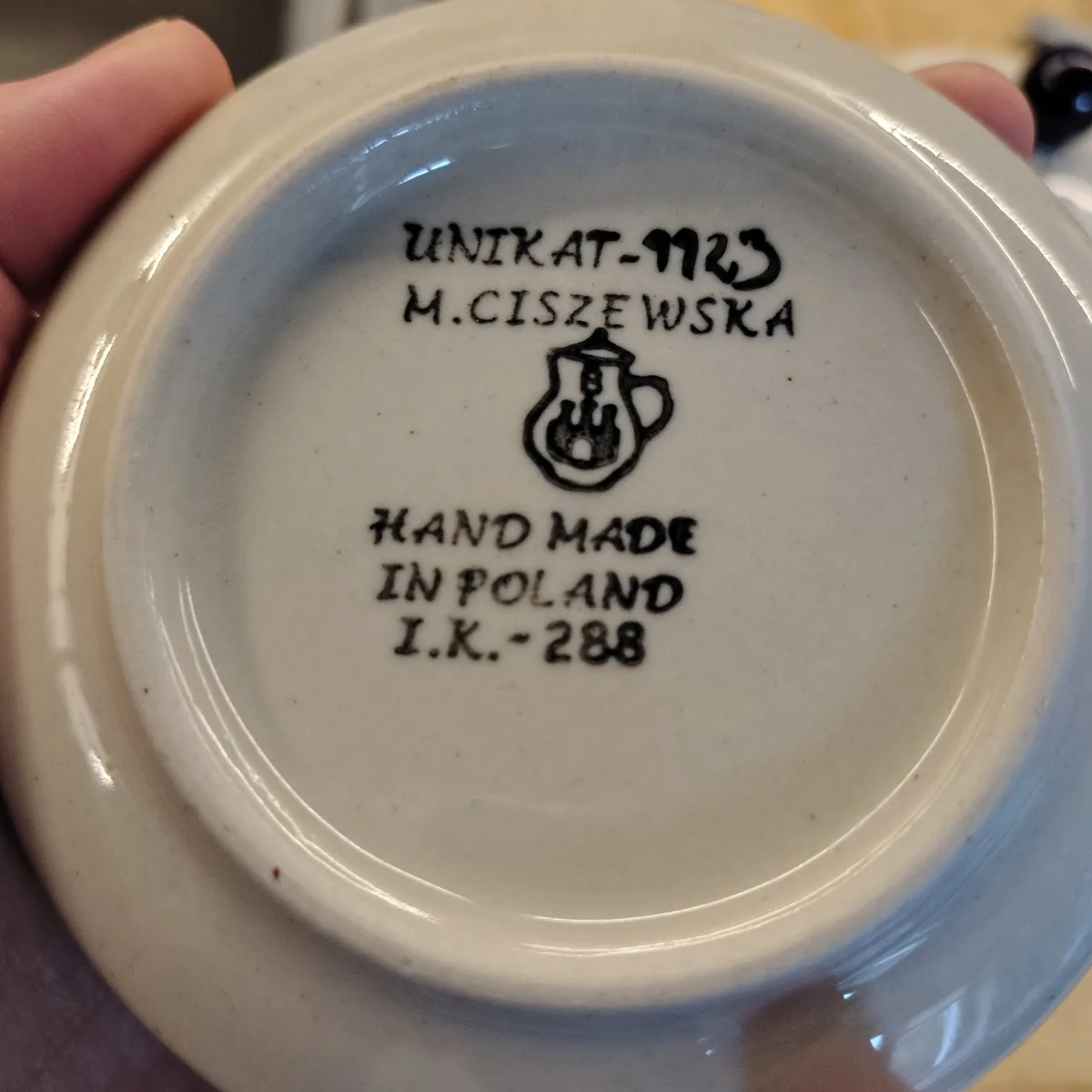
Unikat is what collectors chase. Ceramika Artystyczna's Unikat range is among the best known, and several other makers, including Vena and Zakłady Ceramiczne Bolesławiec, produce signed artistic pieces too.
Choosing a pattern
- Start with one manufacturer. Shapes, sizes and colours vary between factories, so a set from one maker looks more harmonious.
- Mix patterns on purpose. Many collectors combine patterns that share a colour – usually cobalt blue – rather than buying matching sets.
- Buy the pieces you will use. Mugs, small bowls and bakers are the most useful; a large baker or a teapot makes a beautiful centrepiece.
- Use seconds for everyday. Second-quality pieces in classic patterns cost much less in factory shops and are hard to tell from the first quality.
- Watch for discontinued patterns. Factories retire designs regularly; if you love one, buy what you need while it is available.
Where to see the most patterns
The widest choice is in Bolesławiec itself, where factory shops and outlets display thousands of pieces – see Polish pottery outlets and shops. In August, the town's Ceramics Festival brings together producers large and small. The Ceramics Museum in Bolesławiec shows how the patterns developed, from brown-glazed Bunzlau jugs to today's designs.
More about the history, how the pottery is made and how to care for it in our complete guide to Polish pottery.
Sources
- Blue Rose Pottery: The history and meaning of the peacock pattern and Polish pottery pattern guide – pattern and shape codes, Unikat
- Polish Pottery House: Traditional patterns
- Polish Pottery Hagerstown: Our factories – Unikat signatures, pattern numbers on the base
- Ceramika Artystyczna (official website): sponge-stamping technique, Unikat collection
Prices and opening hours change – we re-check them regularly. Spotted something out of date? Let us know.